
What Do People Think of When They Think of Sex?
A Data-Backed Analysis of Word Associations
Despite sex being one of the most studied aspects of human behaviour, there is a surprising lack of data-backed research on the immediate mental associations people have with the word “sex”. While surveys routinely ask about frequency, satisfaction, risk, and behaviour, far fewer studies have examined the language individuals associate with the activity. To address this gap, we conducted an open-ended word association experiment. A total of 157 individuals were asked a single prompt: “What is the first word that comes to mind when you think of sex?"

Participants were not constrained by predefined options. They supplied a single word, allowing us to capture instinctive, top-of-mind associations rather than reflective or socially filtered responses. The result is one of the few quantitative, bottom-up datasets exploring how people linguistically and emotionally frame sex. And the results are conclusive!
A Remarkably Positive Cognitive Landscape
One of the most striking findings was the near-absence of negative associations. Out of 157 responses only two were explicitly negative: “soulless” and “terrible”. Given the prevalence of cultural narratives linking sex to shame, anxiety, obligation, or dysfunction, this result is notable. It suggests that when prompted instinctively rather than reflectively, most people do not associate sex with negativity. Sex is widely perceived as a positive activity… unsurprising really, though you’d have thought more individuals landing on a sex quiz to improve their sex life website would have skewed the results. This aligns with affective psychology research showing that automatic associations often differ from articulated beliefs, particularly in domains shaped by social norms and moral discourse. In short: people like sex!
How People Conceptually Categorise Sex
We categorised all responses into five high-level semantic groups to determine where their minds automatically jump to. The results are: Feeling - 66% Activity - 14% Feature - 8% Partner - 3% Other - 9%
1. Sex Is Primarily Felt, Not Done
The overwhelming dominance of the Feeling category (two-thirds of all responses) suggests that people conceptualise sex less as a mechanical act and more as an emotional, relational, or experiential state. This is consistent with embodied cognition theory, which proposes that abstract concepts are grounded in sensory and affective experience rather than procedural description. In practical terms, it challenges purely performance-based or technique-focused models of sexual wellbeing.
2. Partners Matter Less Than Connection
Only 3% of responses directly referenced a partner (e.g. “wife”, “him”, “her”). This does not imply that partners are unimportant, but rather that sex is not cognitively anchored to a specific person when accessed at a conceptual level. Sex, as it turns out, may still stem from our primordial brains and nature to be polyamorous (monogamy is still a modern day construct, whether you like it or not). Instead, people appear to anchor sex to states(intimacy, pleasure) rather than agents.
The Most Common Words Associated With Sex
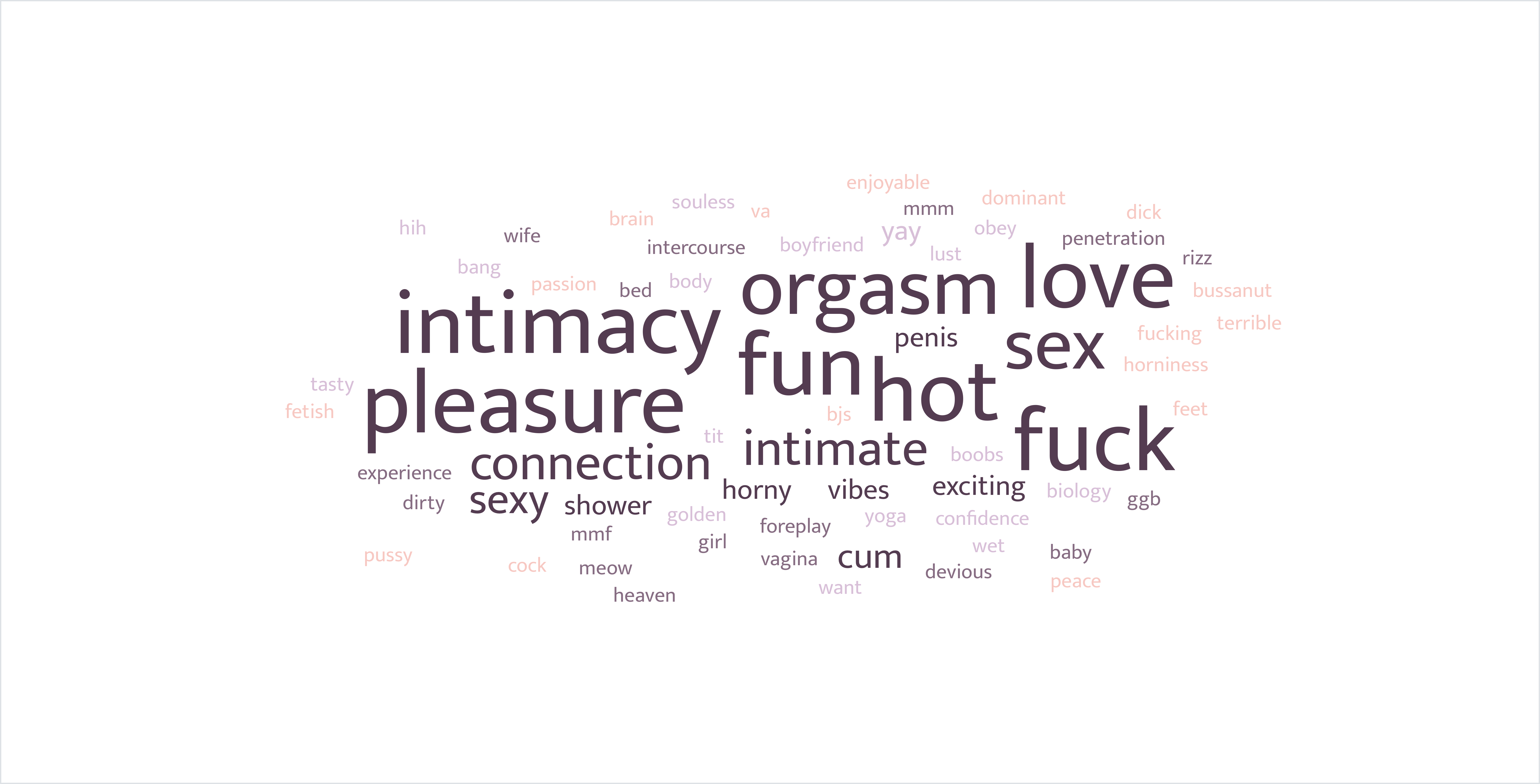
Now for the meat of the research, and possibly the most surprising. The most frequently occurring word associations were: • Intimacy / Intimate – 9.6% • Sex / Sexy – 7.6% • Fuck – 6.4% • Fun – 6.4% • Hot – 6.4% • Love – 6.4% • Orgasm – 5.7% • Pleasure – 5.7% • Genitalia (penis, cock, dick, pussy, vagina) – 4.5% • Connection – 3.2% Several fascinating insights emerge from this distribution.
Intimacy Outranks Pleasure
While pleasure and orgasm are prominent, and many cite it as the main goal of sex, intimacy is the single most common association. This suggests that, cognitively, sex is framed less as an outcome-oriented pursuit and more as a relational process. If we lump “Intimacy” and “Connection” and words that link to their partner (3.2%) together, we find that > 16.0% of respondents directly link sex with connection to their partner – sex is primarily considered an act of connection to another person(s). Comparing 'intimacy' words with 'pleasure' words ("Orgasm", "Pleasure", "Enjoyable" and "Passion"), which account for 12.7%, it's a not-insignificant yet lower than 'intimate' group. This mirrors findings in relationship psychology, where perceived intimacy is often a stronger predictor of sexual satisfaction than frequency or technique. Great sex is rooted in connection (a finding echoed by the trends for our quiz responses too)!
Explicit Language Coexists With Emotional Language
Words like “fuck” sit comfortably alongside “love”, “connection”, and “intimacy”. Rather than indicating a split between emotional and physical framings, this coexistence suggests that explicit sexual language does not preclude emotional meaning. This challenges simplistic binaries between “emotional sex” and “casual sex” and instead points toward a more integrated mental model.
What This Tells Us About Sexual Communication
Taken together, the data suggests that: 1. People think about sex emotionally before mechanically 2. Negative associations are rare at the instinctive level 3. Language around sex is richer and more relational than often assumed Yet, despite this internal framing, many couples struggle to articulate these feelings to one another. This gap between internal association and interpersonal communication is one of the most consistent findings in sex therapy and relationship research. It’s precisely why we built our sex quiz for couples – to help communicate feelings, boundaries, and shared desires.
An Invitation to Collaborate
This word association study is an early example of what becomes possible when sexual research is: • Participant-led rather than assumption-led • Linguistically open rather than prescriptive • Designed for scale without sacrificing nuance We believe there is substantial untapped potential in combining academic research methods with modern, user-centred sexual wellbeing tools. If you are a researcher, clinician, or academic institution interested in collaboration, data access, or joint studies in sexual psychology, communication, or relational wellbeing, we welcome you to get in touch. Better data leads to better conversations - and better conversations lead to better sex.